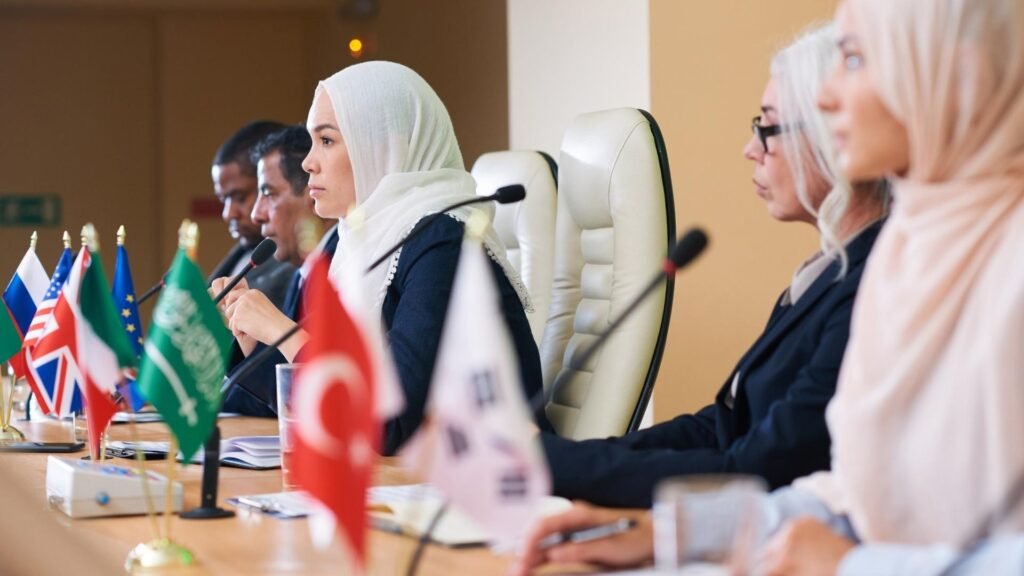
When people hear “freedom index,” they rarely think of the Muslim world. Yet behind the headlines, a quieter transformation is taking place.
The Islam and Liberty Index (ILN Index)—developed by the Islam & Liberty Network (ILN)—offers a new way to measure what freedom actually looks like in Muslim-majority countries. Not just economic opportunity, but also religious and political liberty.
The 2024 report, presented at the 11th Islam and Liberty Conference in Istanbul, reveals both surprising leaders and persistent gaps.
A ILN Lens on Freedom
Unlike conventional indices that mix liberty with development indicators like GDP or schooling, the ILN Index keeps a sharp focus on three kinds of freedom:
- Religious freedom: the right to believe, practice, and express faith without fear;
- Political freedom: the rule of law, democratic participation, and civil liberties;
- Economic freedom: open markets, voluntary exchange, and limited government.
Each is given equal weight — because a society cannot be truly free if any one of these pillars is weak.
What the Data Say
The 2024 results covered 56 OIC member and observer states, revealing a fascinating geography of freedom:
- Top performers: The Gambia, Suriname, Albania, Guyana, Senegal, and Bosnia and Herzegovina lead the index, each scoring above 7.0 on a 10-point scale.
- Regional contrasts: Sub-Saharan Africa stands out, home to half of the top-ten countries, while the Middle East and Asia-Pacific remain behind despite greater wealth.
- Newcomers to the “most free” list: Bosnia and Herzegovina and Sierra Leone joined in 2024, reflecting modest but real improvements in political and religious rights.
Interestingly, the countries leading in freedom represent only 2% of the global Muslim population, yet their models may offer blueprints for gradual reform elsewhere.
The Three Faces of Freedom
1. Religious Freedom – A Mixed Picture
While many countries improved slightly, religious freedom remains uneven.
Comoros, Oman, Djibouti, and Gabon now rank among the highest, while Sudan’s recovery lifted it back into the “most free” category after years of restriction.
Still, the most populous Muslim nations—Indonesia, Pakistan, and Egypt—continue to struggle with religious intolerance, limiting progress at the global level.
2. Political Freedom – The Weakest Link
No OIC state scored above 7.0 in political freedom. Even where elections occur, restrictions on association, media, and opposition persist.
Yet progress exists: The Gambia and Bosnia and Herzegovina both improved, joining Albania, Malaysia, and Senegal as relative bright spots.
3. Economic Freedom – The Strongest Dimension
If politics disappoints, markets perform better. Over half the OIC countries achieved scores above 7.0 in economic freedom.
Top performers include Bahrain, Kuwait, Oman, Saudi Arabia, and the UAE—states with open markets and stable monetary policies.
Still, high economic scores do not always translate into personal liberty. A country may allow trade, yet limit speech. The ILN Index reveals these internal contradictions.
Patterns Behind the Numbers
The 2024 analysis highlights a deeper paradox: the most populous and economically powerful Muslim countries remain among the least free.
Nations like Indonesia, Pakistan, Egypt, Iran, and Türkiye have massive demographic and economic weight—but relatively low freedom scores. Their values and policies influence the entire OIC sphere, shaping norms that affect smaller, freer nations.
At the same time, the Index shows that freedom and prosperity are not mutually exclusive. Small, low-income nations like The Gambia and Senegal demonstrate that liberty does not depend on wealth — it depends on political will.
Why Measuring Freedom Matters
Freedom cannot be improved if it is not measured. The ILN Index provides a mirror for the Muslim world, allowing policymakers, academics, and civil society to see where progress is being made—and where it is not.
By focusing on clear, evidence-based indicators (from Pew Research, Cato Institute, and others), the Index moves the conversation beyond ideology and toward practical reform.
Final Thought
Freedom in Muslim societies is not a Western aspiration — it is a universal Islamic value rooted in justice (adl), accountability (hisbah), and voluntary action (ikhtiyar).
The 2024 Islam and Liberty Index reminds us that liberty is not an abstract goal but a measurable condition — one that can, and must, improve through informed effort and honest assessment.
Read the full study: Omerčević, E. (2024, October). The Islam and Liberty Index 2024: An Overview of Religious, Political, and Economic Freedom in OIC States.
Paper presented at the 11th International Islam and Liberty Conference: The Role of Civil Values and Institutions in Muslim Societies, Istanbul, Turkey.